Semiconductor wafer positioning rarely involves just one type of motion. The same stage may need relatively long travel to bring a wafer into position, followed by fast, precise motion for focusing, measurement, or inspection. In many systems, rotational correction is also required to compensate for angular misalignment.
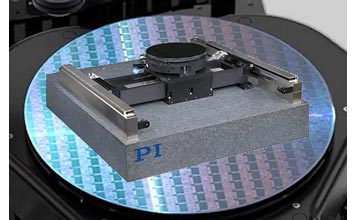
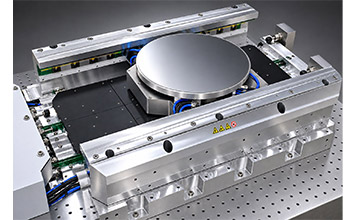
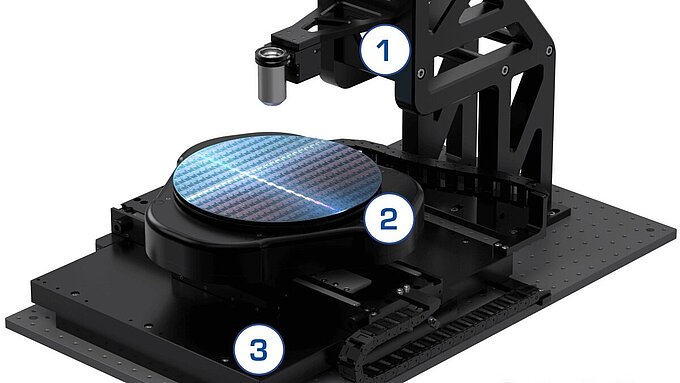
A drive and kinematics concept developed by PI engineers demonstrates how PICMAWalk PiezoWalk motor technology can combine these requirements within a more integrated mechanical design, using a four-axis wafer positioning system as an example.
A More Configurable Piezo Walk Drive
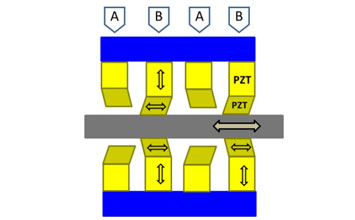
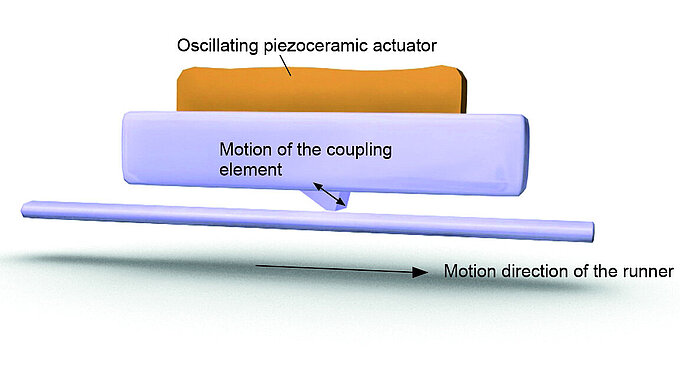
PI's PiezoWalk drive family includes NEXACT (cofired), NEXLINE (individual discrete linear and shear actuators), and PICMAWalk (V2 to V8 configurations) technologies. All these PiezoWalk motors provide two operating modes: an incremental stepping mode, and an “analog”, short stroke, high-resolution, high-bandwidth mode. A key difference with PICMAWalk is the construction of the drive modules. Instead of using technology-specific piezo modules, PICMAWalk uses pairs of standard PICMA® multilayer piezo stack linear actuators. This gives engineers more flexibility when adapting the drive to a particular motion requirement.
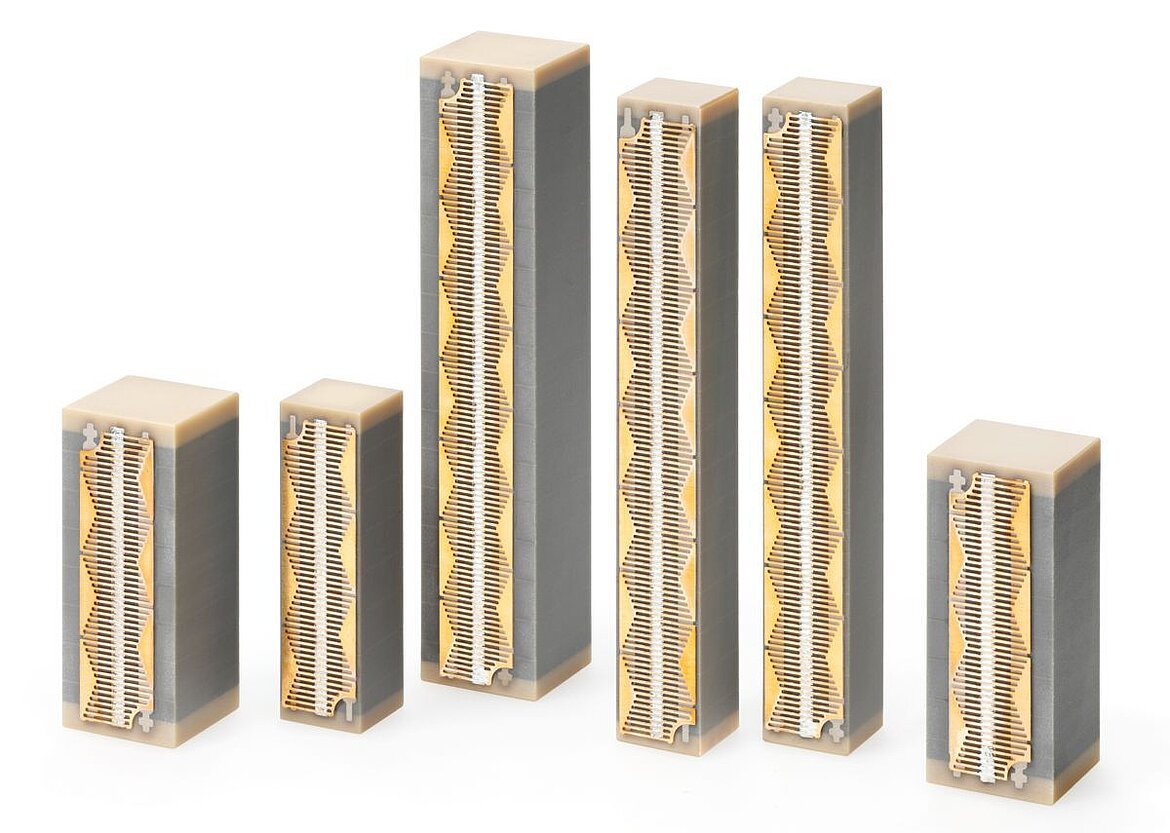
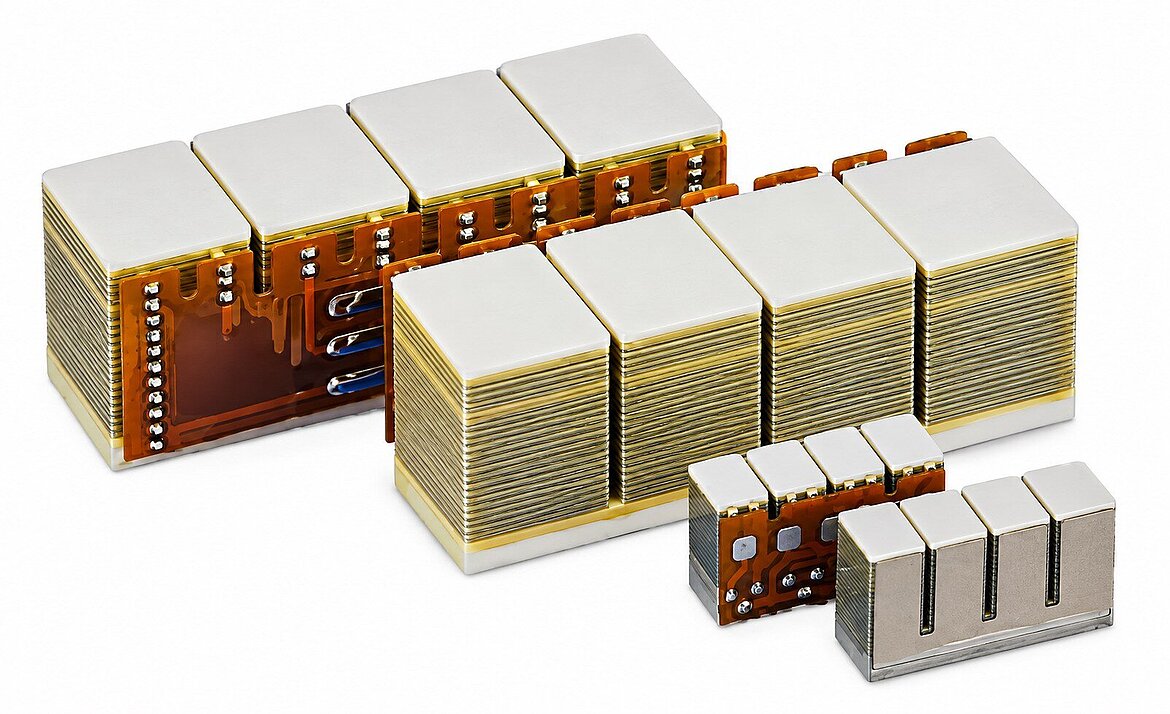
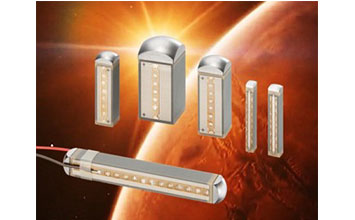
Different standard actuators can be selected to adjust characteristics, such as stiffness, active and passive drive force, lift-off behavior, step size, and analog positioning range. This modular approach also provides a practical path toward application-specific drive designs without developing the actuator technology from scratch. PICMA® actuators have been used by NASA for several space missions, after passing 100 billion cycles of lifetime tests without failures.
Tuning Performance Through Mechanical Design
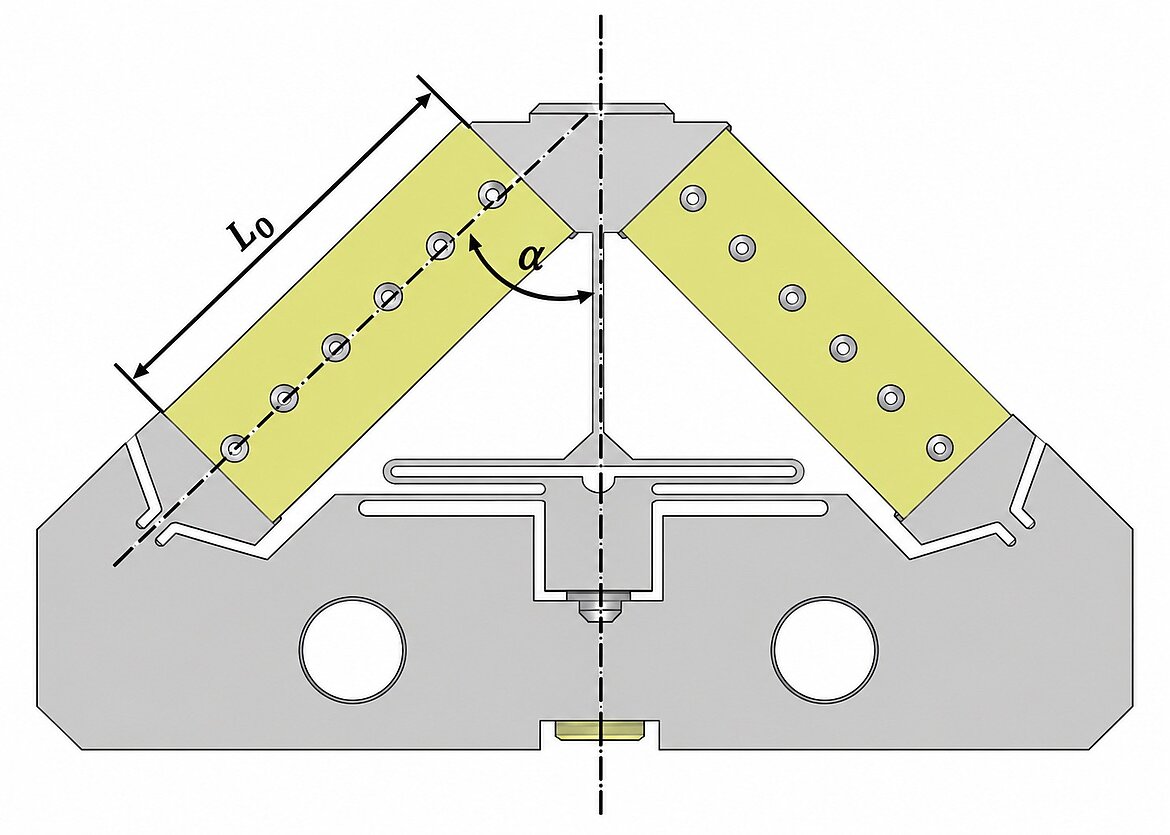
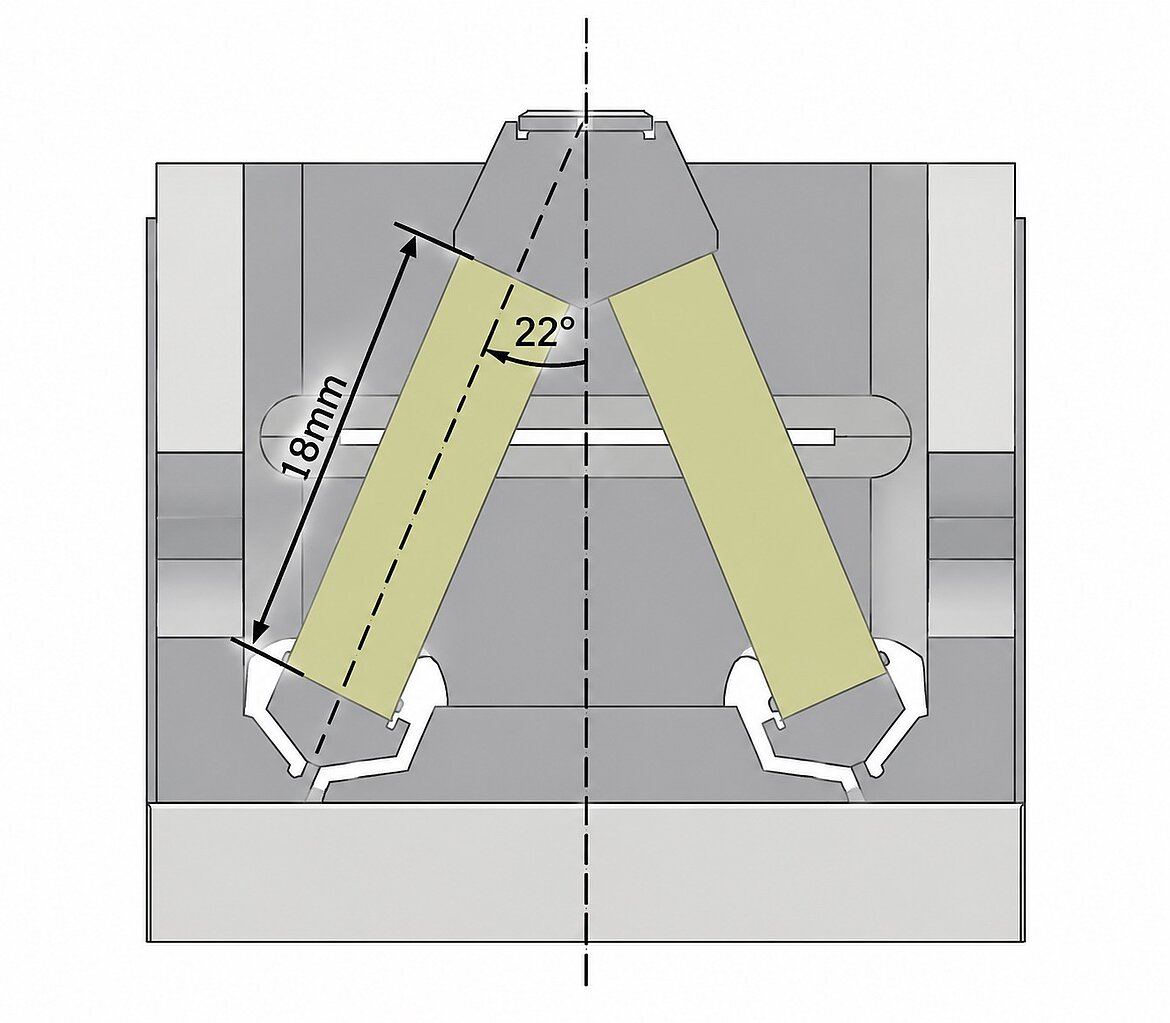
Actuator selection is only part of the design. The mechanical geometry of a PICMAWalk drive provides another way to tune its behavior. One important variable is the inclination angle of the piezo actuators. A shallower angle increases the available vertical motion and can improve lift-off behavior. Increasing the angle produces a larger shear component, which increases step size and the available analog positioning range.
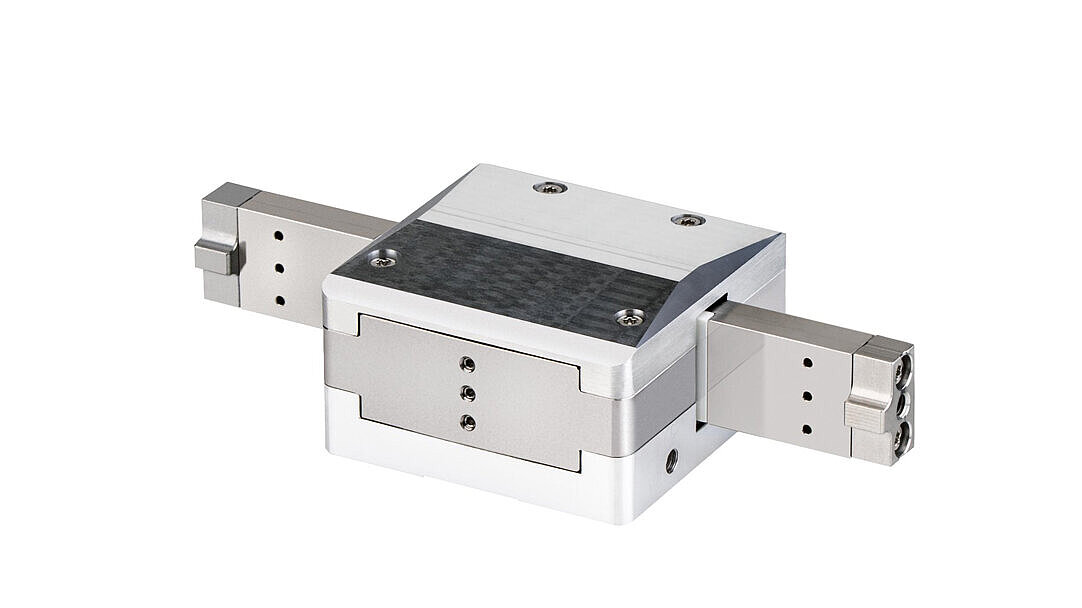
Engineers can therefore modify important motion characteristics through both actuator selection and drive geometry, while retaining the same basic PICMAWalk operating principle.
Combining Long Travel and Dynamic Fine Positioning
The benefit of this approach becomes particularly clear in the wafer-stage example. The Z-axis has two very different motion requirements:
- Initial positioning range: 2,000µm
- Dynamic focus tracking range: 50µm
In the NEXLINE-motor-based configuration, the dynamic focus motion requires an additional translational piezo axis, due to the short vertical travel of the Z-actuator sections in the motor. Placing the walking drive and fine-positioning axis in series reduces overall stiffness, adds mechanical complexity, and requires two independent measurement systems.
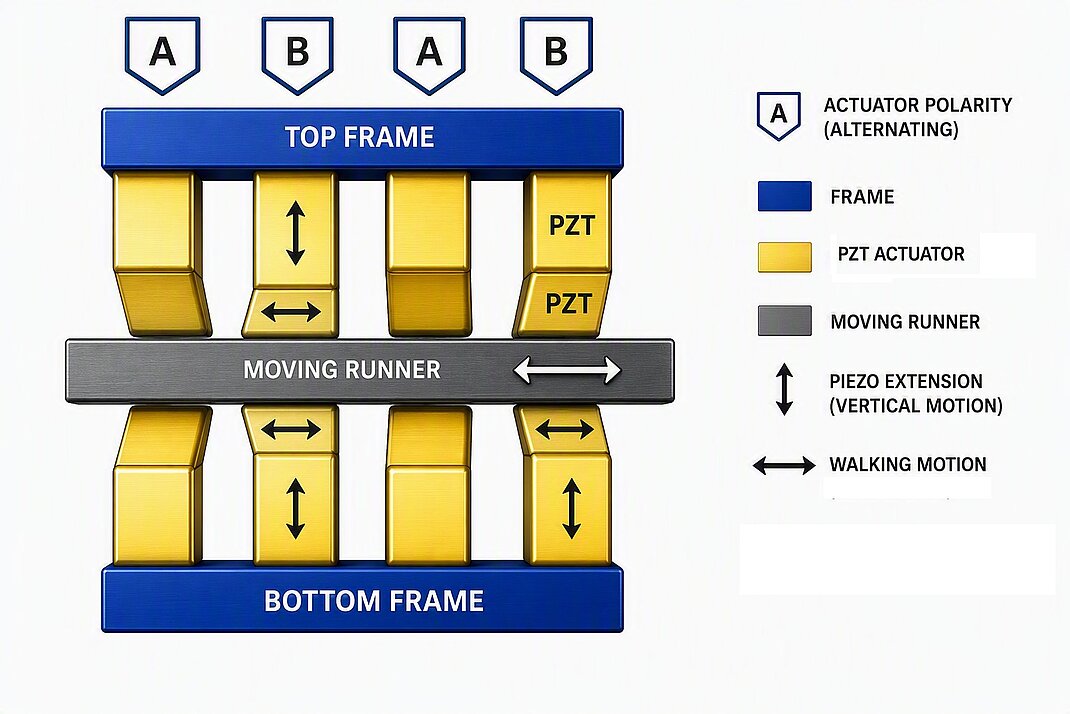
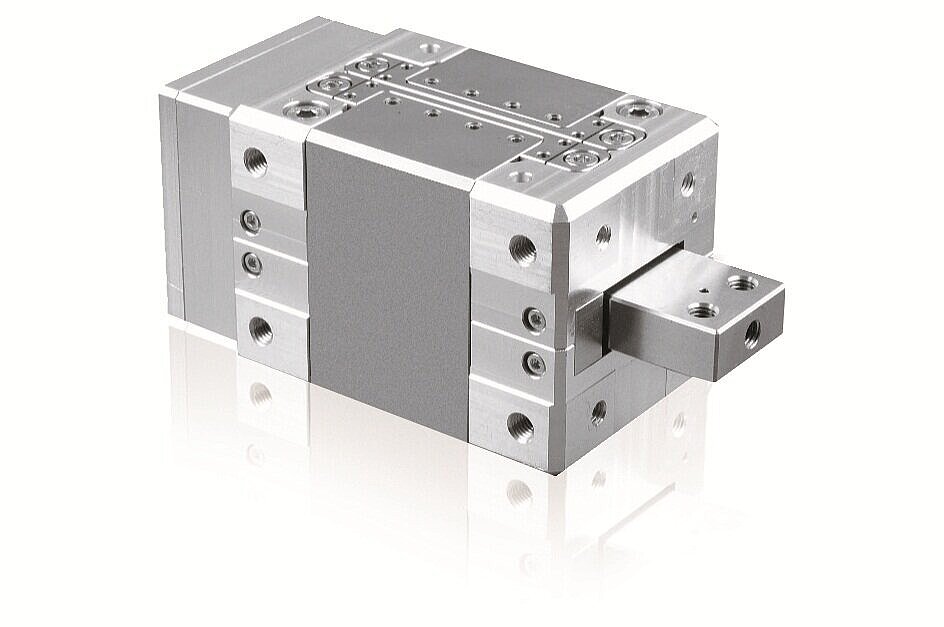
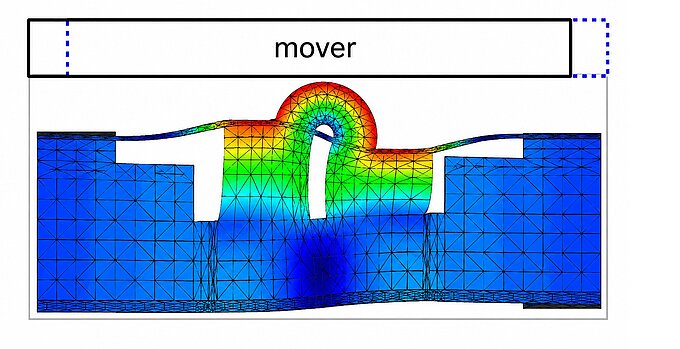
PICMAWalk provides a way to combine these functions. In the application-specific design, P-885.50 PICMA® actuators are integrated into a flexure-guided structure at an inclination angle of 22°.
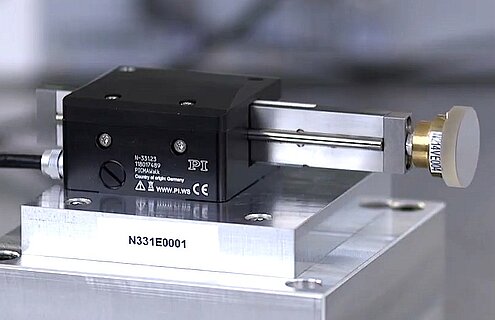
The resulting system provides an analog dynamic positioning range of 56µm at nominal piezo stroke, exceeding the 50µm required for focus tracking. The same actuator system can therefore operate in two modes: repetitive, walking motion for the relatively long initial positioning move and analog piezo motion for fast, short-range focus correction.
For the wafer stage, this removes the need for a separate fine-positioning piezo axis and simplifies both the mechanical arrangement and the control architecture.
Extending the Same Principle to Rotary Motion
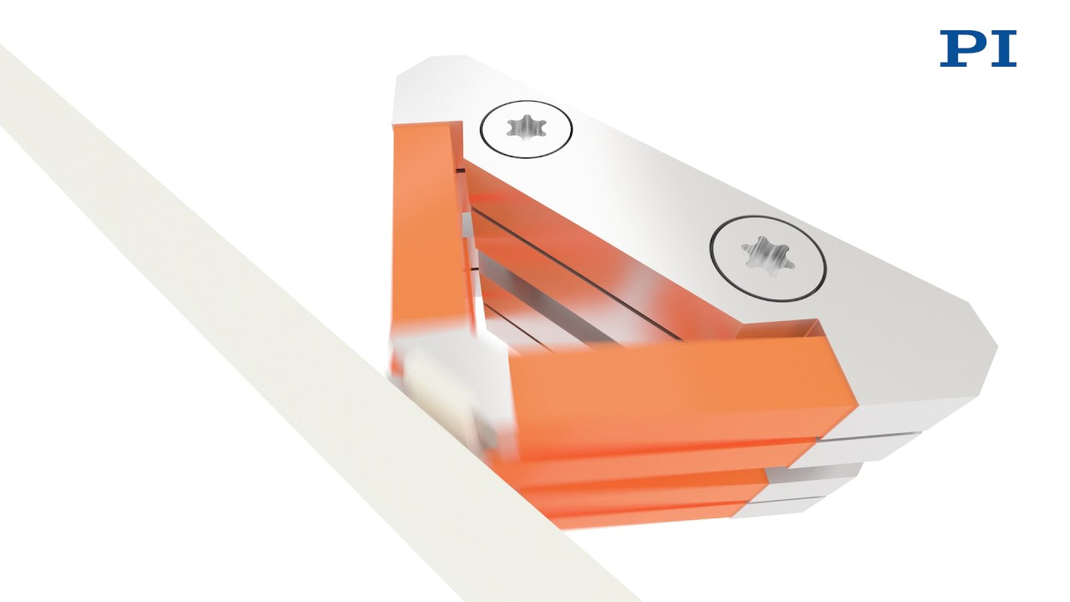
PICMAWalk is not limited to linear positioning. Individual drive segments can also be arranged around a circular runner. In a configuration with 2 × 3 parallel-connected drive segments, three uniformly distributed contact points are established on the runner (output) during the stepping motion. Combined with a rotary bearing, the translational stepping action of the individual segments generates rotary motion.
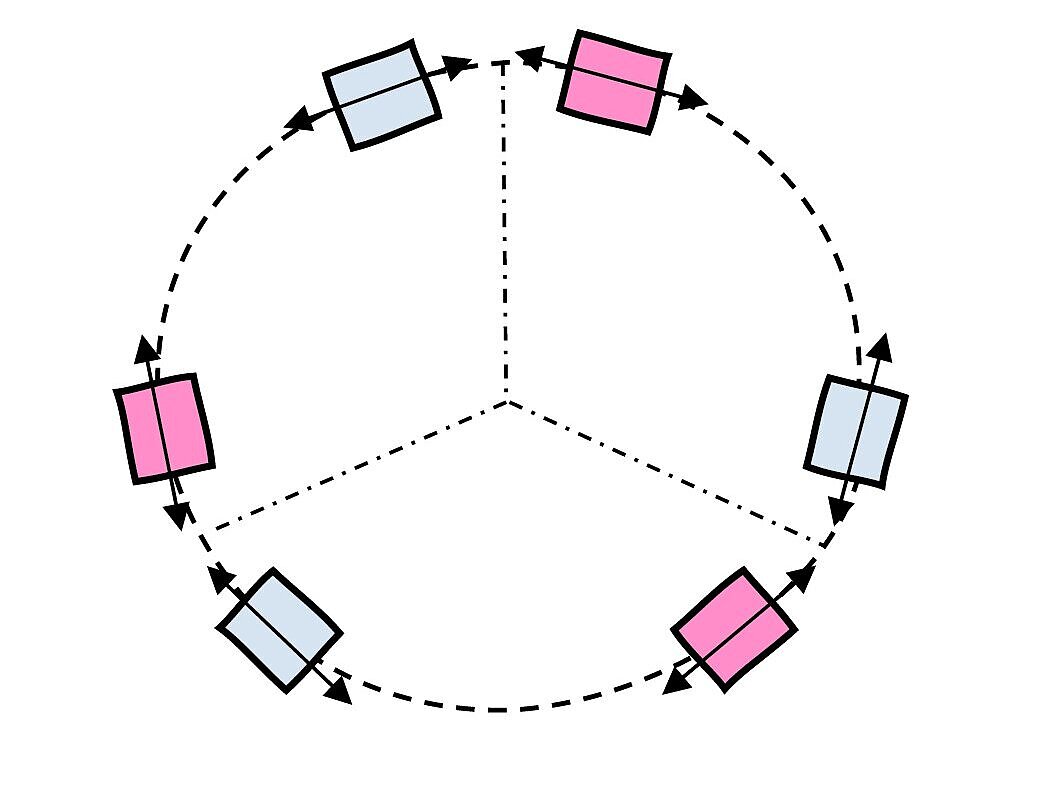

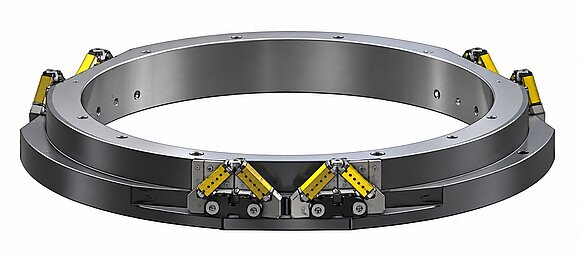
The wafer stage uses this arrangement for its RotZ axis, which compensates for angular misalignment over a range of up to 17.4 mrad. A conventional tangential linear drive can introduce direction-dependent stiffness because the mechanical arrangement is asymmetric. It can also restrict the available rotation angle.
The circular PICMAWalk arrangement addresses these limitations with a symmetric drive geometry, providing more uniform stiffness around the rotational axis. With an appropriate rotary bearing, the concept can also support continuous rotation beyond 360°.
One Drive Principle Satisfies Multiple Motion Requirements
The wafer-stage example illustrates perhaps the most useful aspect of PICMAWalk from an engineering perspective: the drive architecture can be adapted to the motion requirement rather than forcing the positioning system around a fixed drive design.
Standard PICMA® actuators provide the basic building blocks. Actuator selection can modify force and stiffness. Drive geometry can be adjusted to change step size, lift-off behavior, and analog positioning range. And the arrangement of the drive segments can produce either linear or rotary motion.
For semiconductor positioning systems, that flexibility creates opportunities to consolidate functions that would otherwise require separate positioning mechanisms. Long travel, dynamic fine positioning, and angular correction can potentially be addressed using variations of the same fundamental drive principle.


Blog Categories
- Aero-Space
- Air Bearing Stages, Components, Systems
- Astronomy
- Automation, Nano-Automation
- Beamline Instrumentation
- Bio-Medical
- Hexapods
- Imaging & Microscopy
- Laser Machining, Processing
- Linear Actuators
- Linear Motor, Positioning System
- Metrology
- Microscopy
- Motorized Precision Positioners
- Multi-Axis Motion
- NanoAutomation
- Nanopositioning
- Photonics
- Piezo Actuators, Motors
- Piezo Mechanics
- Piezo Transducers / Sensors
- Precision Machining
- Semicon
- Software Tools
- UHV Positioning Stage
- Voice Coil Linear Actuator
- X-Ray Spectroscopy