Multiplexed Control of Closed-Loop Piezo Actuators
Reducing Electronics in Large Multi-Axis & Array Systems
Piezoelectric actuators are widely used in adaptive optics because they combine high positioning resolution, stiffness, fast response, useful stroke, and mechanical robustness. The challenge comes when the number of actuators increases.
A deformable mirror with hundreds or thousands of actuators conventionally requires a dedicated high-voltage amplifier for every actuator / channel. This approach provides continuous, independent control, but the electronics become increasingly large, expensive, and power-intensive as channel count grows.
A different approach is to share the drive electronics among multiple piezo actuators. This article describes how a research team at PI developed and tested a multiplexed system for closed-loop operation, with a focus on the factors that limit its performance.
Using the Piezo Actuator as a Charge Storage Device
Multiplexing works particularly well with piezo actuators because of their capacitive behavior. Once charged to a given voltage, a piezo actuator can maintain approximately the same displacement after being electrically disconnected. Position changes take place gradually due to leakage and creep, but unlike, for example, a voice coil actuator, in a piezo mechanical device, holding force does not depend on operating current and it does not immediately return to its unpowered position.
This makes sequential addressing possible. Instead of providing every actuator with its own high-voltage amplifier, one amplifier can be switched between several actuators. Each actuator is driven to the required position and disconnected while the amplifier addresses the other channels.
For a system containing a large number of piezo channels, this architecture could significantly reduce the amount of high-voltage drive electronics.
Testing the Multiplexed Approach
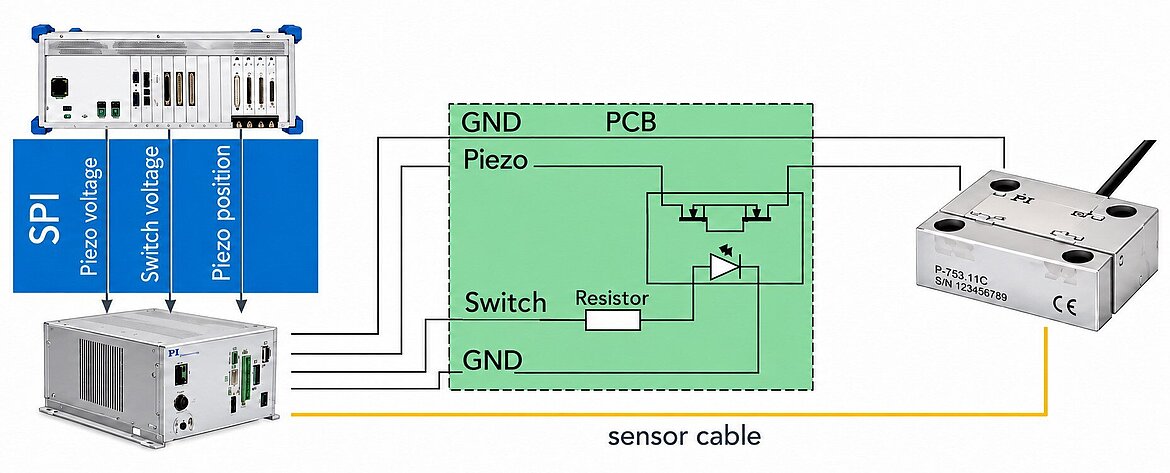
To investigate the switching behavior without the added complexity of a deformable mirror, the researchers used a P-753.11C LISA linear piezo positioning stage as the device under test.
The stage provides 15 µm travel and uses a PICMA® piezo actuator with approximately 1.5 µF capacitance and a displacement of ~15µm at ~100V operating voltage. An integrated capacitive displacement sensor measures the platform position with 0.1 nm resolution. High-voltage switching was performed using optically isolated PhotoMOS solid-state relays.
The experimental arrangement, shown in the image above, combines the piezo nanopositioning stage, switching electronics, real-time control hardware, and an E-727 controller used as the high-voltage amplifier and capacitive-sensor interface.
The PhotoMOS relays are an important part of the experiment because switching is not instantaneous. Measured turn-on time was approximately 100 to 150 µs, while turn-off required about 50 µs. These delays become significant as switching frequency increases.
Closed-Loop Control Requires a Different Strategy
Simply switching a conventional closed-loop controller between actuators creates another problem.
During the time an actuator is disconnected, the controller can still see a position error. If the integral term continues accumulating that error while the actuator cannot respond, the controller output can build up. When the channel is reconnected, the accumulated correction can produce excessive overshoot or instability.
The control architecture therefore freezes the integral state whenever the actuator is disconnected. Integration resumes only when that actuator is actively addressed.
This is a relatively small change to the control structure, but it is essential for making sequential closed-loop operation practical.
What Determines Settling Time?
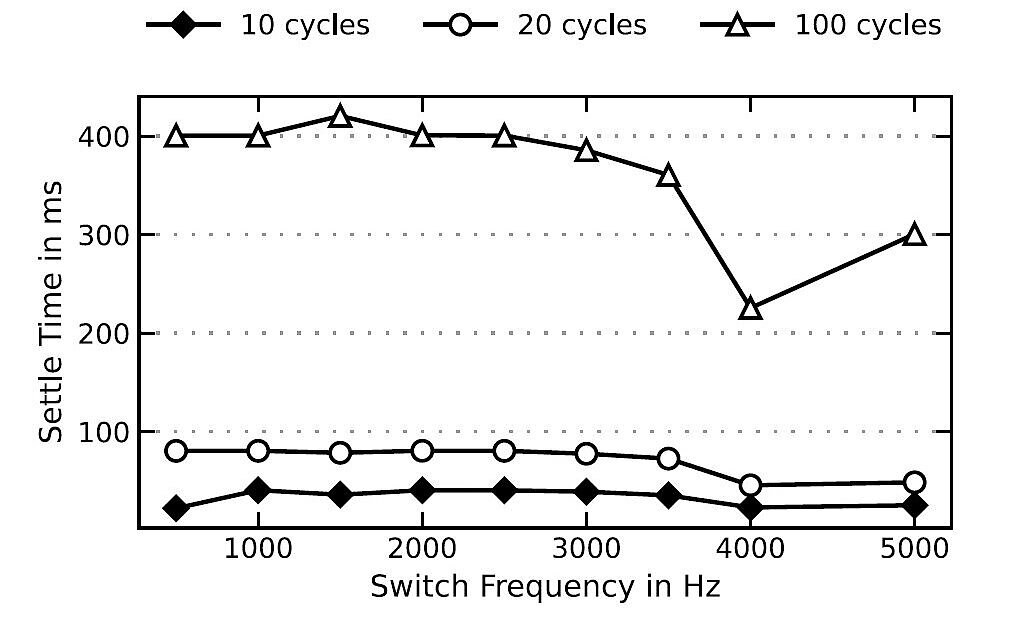
The engineers varied switching frequency and the number of cycles between successive updates of the physical actuator. These additional delays emulate other actuators being serviced by the same amplifier. For example, addressing the physical actuator once every tenth switching cycle represents a system in which nine other channels are addressed before returning to that actuator. As more virtual actuators are added, each actuator is updated less frequently.
The results reveal an interesting tradeoff: For a 7µm step, increasing switching frequency did not substantially improve settling time. A higher switching frequency provides more opportunities to update the actuator, but each switching cycle also becomes shorter. That reduces the time available to charge the actuator and apply corrective control.
The two effects largely offset each other. The number of virtual actuators had a much stronger influence. As more channels share the drive electronics, the interval between updates of an individual actuator increases, resulting in longer settling times. In other words, simply increasing the multiplexing frequency is not enough. The available electrical on-time per actuator still matters.
Dead Time Is Critical to Prevent Crosstalk
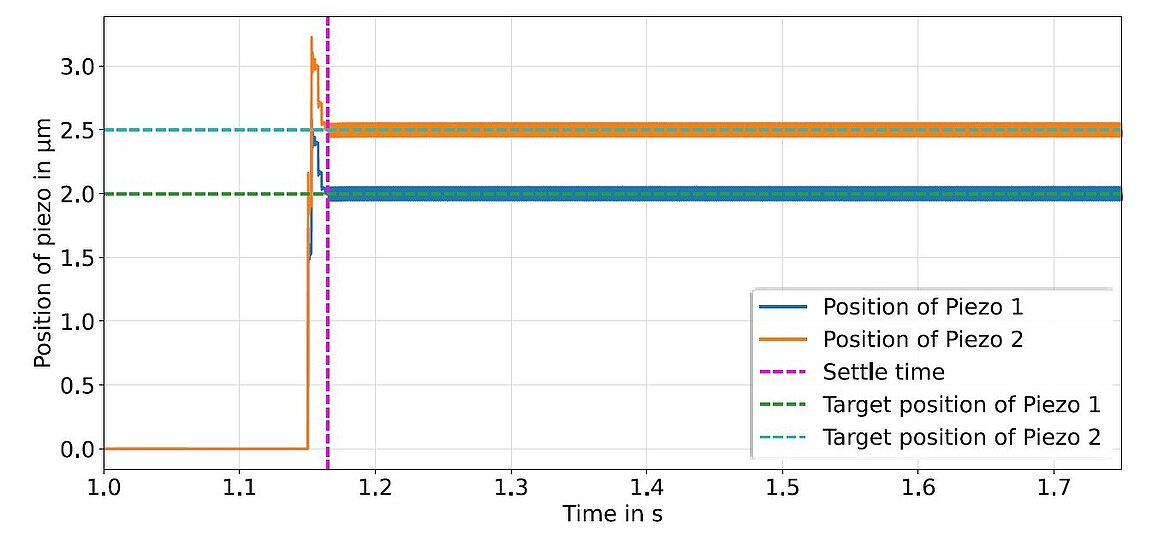
A second experiment used two physical piezo actuators with independent switching elements. This setup was used to investigate the transition from one channel to another and determine how much separation is required between switching events.
At a 4 kHz switching frequency, one actuator received a command to provide a displacement of 2 µm while the second received a 2.5 µm command. With no additional dead time, the voltage commands interfered with the opposite channel, producing visible oscillations in the measured position.
The cause is straightforward: if one cycle has not been completed before the next channel is connected, the switching periods overlap. This can cause unintended charge transfer, current spikes, and incorrect actuator voltages.
In this experimental configuration, a 120 µs dead time was the shortest interval that provided sufficient isolation between the piezo channels. With adequate dead time, stable and repeatable operation was achieved even at high switching frequencies. This is an important design consideration. Multiplexing performance is determined not only by actuator dynamics and controller bandwidth, but also by the electrical behavior of the switching hardware.
Scaling to Larger Piezo Actuator Numbers
These experiments demonstrate the feasibility of closed-loop multiplexed piezo control with relatively simple hardware. They also show where the engineering challenges lie.
The dominant limitations observed in these tests were associated with the interaction between switching behavior and controller timing rather than the dynamics of the piezo actuator itself. Scaling the approach to larger actuator arrays will therefore require faster and more tightly synchronized switching architectures, potentially including dedicated switching controllers or integrated high-voltage multiplexers.
More sophisticated control strategies may also help. Adaptive or gain-scheduled controllers, for example, could apply more aggressive control during large moves and reduce the gain as the actuator approaches its target.
The current experiments intentionally isolate the electrical and control aspects of multiplexing. A single linear stage cannot reproduce the mechanical coupling between neighboring actuators in a deformable mirror or active surface. The next step is therefore testing with true multi-actuator systems, where switching dynamics, mechanical coupling, and actuator influence functions all interact.
For adaptive optics and other applications requiring large arrays of piezo actuators, the potential benefit is significant: fewer high-voltage amplifier channels without giving up closed-loop positioning at each actuator. The engineering challenge is making sure that switching time, dead time, control bandwidth, and the number of multiplexed channels are treated as parts of the same system.
» Read the full paper by Sebastian Kist, Max Bauer, Jonas Reiser



Blog Categories
- Aero-Space
- Air Bearing Stages, Components, Systems
- Astronomy
- Automation, Nano-Automation
- Beamline Instrumentation
- Bio-Medical
- Hexapods
- Imaging & Microscopy
- Laser Machining, Processing
- Linear Actuators
- Linear Motor, Positioning System
- Metrology
- Microscopy
- Motorized Precision Positioners
- Multi-Axis Motion
- NanoAutomation
- Nanopositioning
- Photonics
- Piezo Actuators, Motors
- Piezo Mechanics
- Piezo Transducers / Sensors
- Precision Machining
- Semicon
- Software Tools
- UHV Positioning Stage
- Voice Coil Linear Actuator
- X-Ray Spectroscopy