Quantum technology, low-temperature microscopy, and materials research increasingly require precise positioning inside cryogenic environments. Aligning a sample, optical component, or quantum sensor can require both translation and rotation within a tightly restricted space.
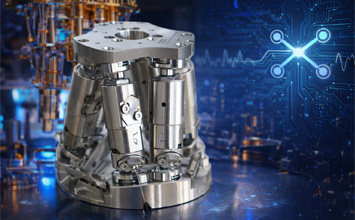
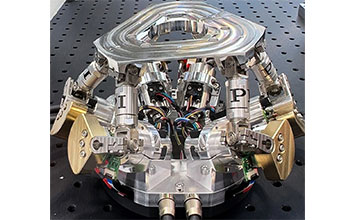
A team of researchers at PI have developed and qualified three compact parallel-kinematic prototypes designed for six-degree-of-freedom positioning at temperatures down to 4K.
Six Degrees of Freedom in a Compact Structure
The systems use a Stewart-platform architecture: six length-adjustable struts position and orient a shared platform. This parallel-kinematic arrangement provides six-axis motion without stacking individual translation and rotation stages.
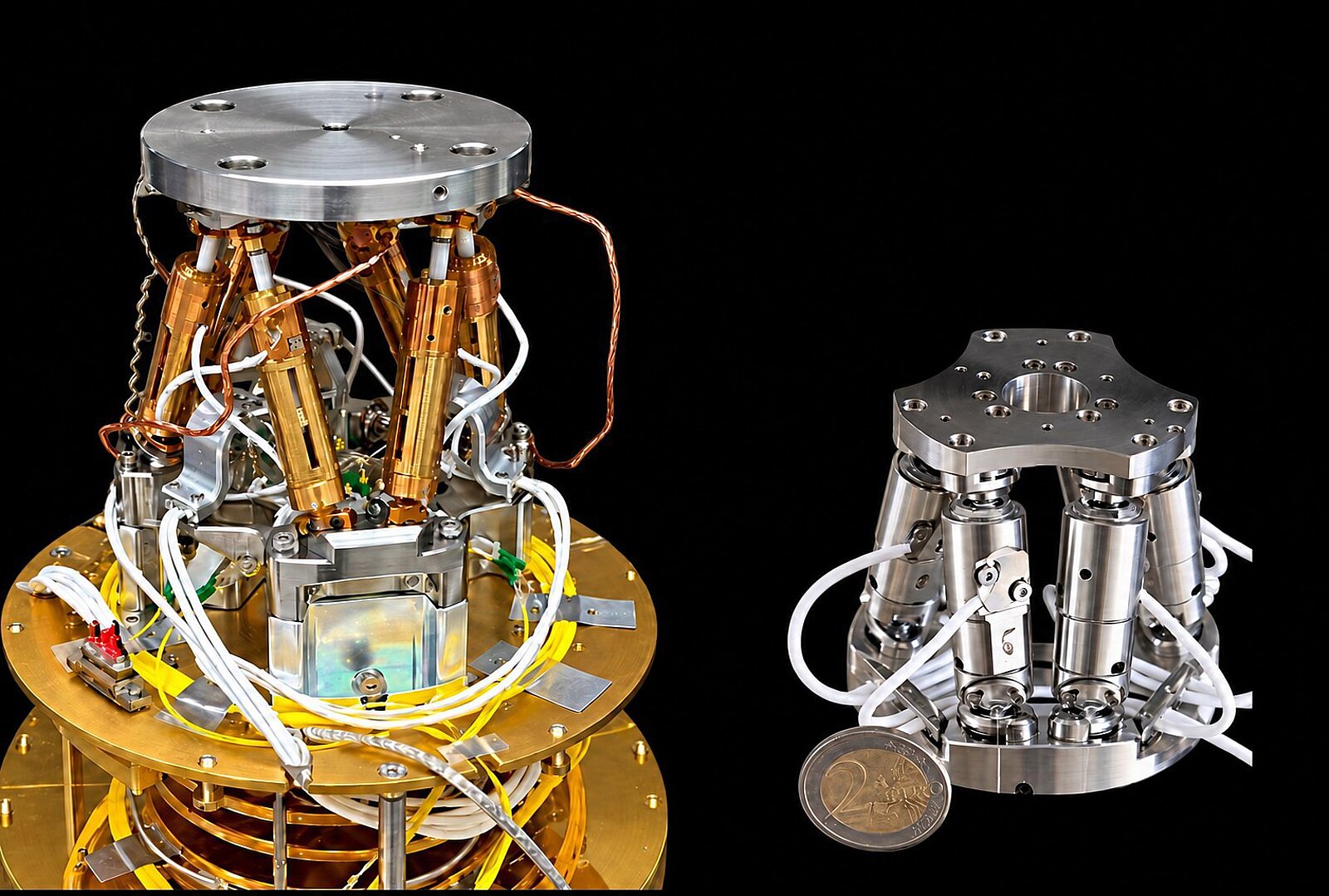
Different variants were developed to provide millimeter-scale motion, with a payload exceeding 500g at 4K. Variants V1 and V3 are 66mm high; the larger V2 is 106mm high. V1 is made primarily from stainless steel, while V2 and V3 mainly use bronze and titanium for their non-magnetic properties. Materials used across the designs include bronze, titanium, aluminum, zirconium oxide, steel, and PZT ceramic, selected to support ultra-high-vacuum (UHV) compatibility and largely non-magnetic construction.
Piezo Inertia Drives Adapted for Extreme Cold
Each strut uses piezo inertia actuator. Operation at 4K presents a significant challenge. The measured piezoelectric response drops to approximately 20% of its room-temperature value
Drive-shoe preload is also critical for reliable operation. Initial testing showed robust motion when the assembled actuator's holding force did not exceed approximately 5 to 6N.
The team qualified individual struts by measuring the force required to initiate slipping and characterizing motion at different drive voltages. Experiments with a modified driver investigated how increased voltage could provide more piezo stroke at very low temperatures.
Interferometric Feedback Inside Each Strut
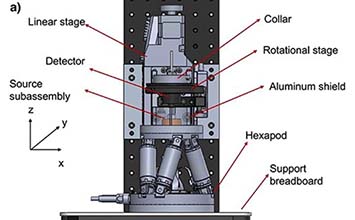
PI Range Resolved Interferometer (PIRRI) feedback measures the position of the individual struts with nanometer-scale resolution. Passive interferometer heads are located inside the cryostat and connected through single-mode fibers to electronics outside it. The approach provides a larger measurement range than capacitive sensors.
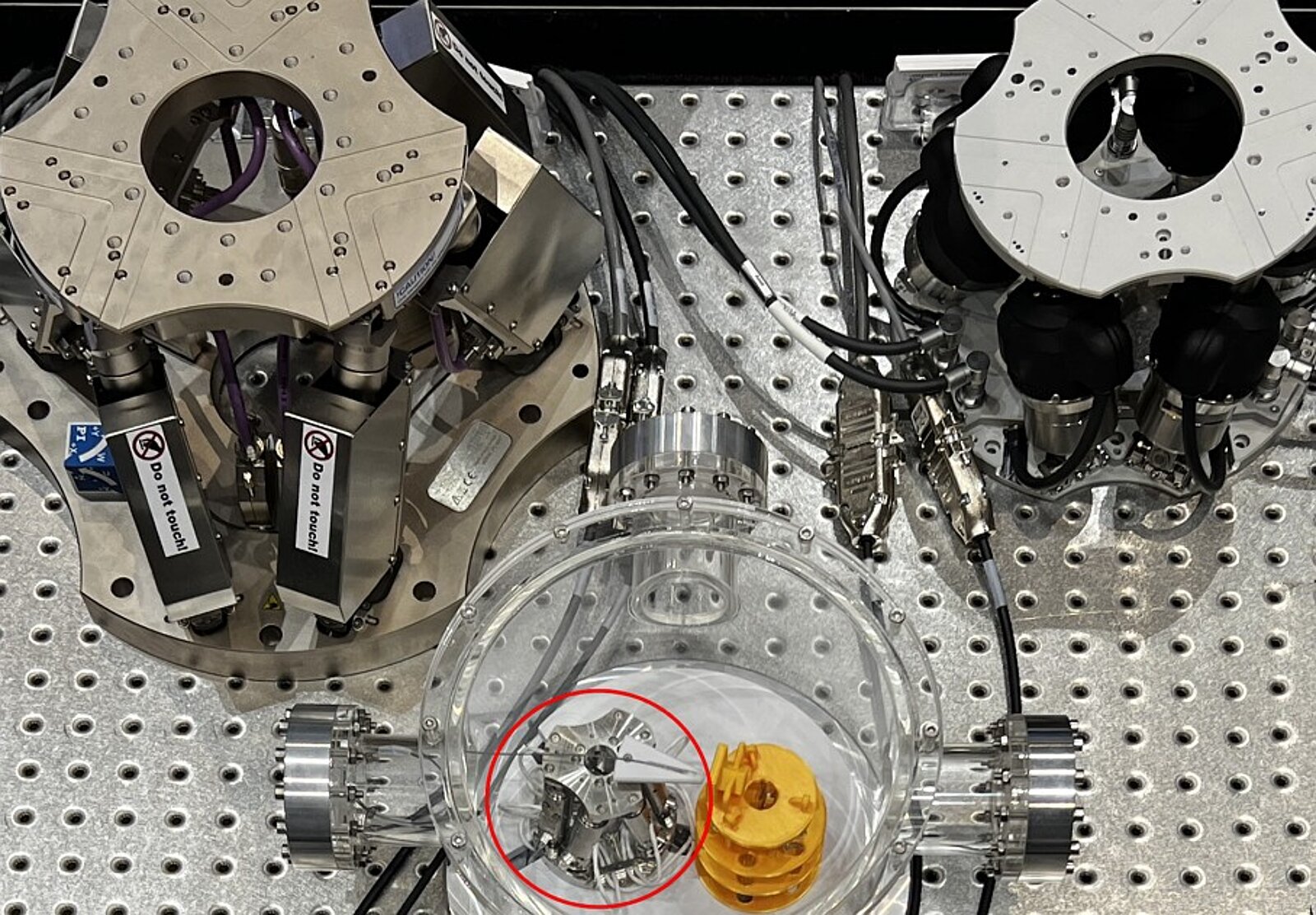
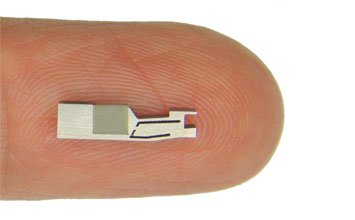
Thermal contraction makes optical alignment particularly challenging. Cooling by several hundred Kelvin can produce significant misalignment, making conventional pre-alignment to a mirror impractical.
The researchers therefore evaluated different kinds of retroreflective structures.
Control and Integration Around the Application
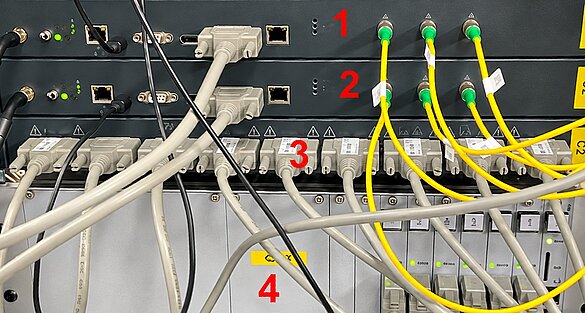
The experimental control architecture combines two three-channel PIRRI controllers with a C-886.31 hexapod controller and six E-873 single-axis driver boards for the piezo inertia actuators.
V2 and V3 also demonstrate different approaches to system integration. V2 routes the optical fibers internally through connectors in the base plate. V3 uses external fiber routing and a freely adaptable carrier, allowing the configuration to be adapted to the customer's environment.
Motion speed can be adjusted from a few millimeters per second down to micrometers per second, providing a way to minimize thermal dissipation within a given time frame. Future electronics described in the paper are based on the E-713 controller with dedicated cryogenic driver boards.
Demonstrated Capability and Next Development Steps
The work demonstrates the feasibility of compact six-axis positioning with a payload exceeding 500g at temperatures as low as 4K. It also identifies the engineering work required to improve robustness.
In some of the cryogenic tests, actuators can became stuck even with what was originally determined the correct preload.
Planned developments include new drive electronics, a new alignment algorithm, and a modified sensor configuration.
The prototypes have demonstrated how parallel kinematics, piezo inertia actuation, and interferometric feedback can be combined for coordinated translation and rotation in a cryogenic environment. They also demonstrate that successful positioning at 4K requires more than selecting cryo-compatible components. Actuation, preload, optical alignment, sensing, electronics, materials, and thermal dissipation must be engineered as one system.
Discuss Your Cryogenic Application with PI
Whether your application involves aligning fiber optics, positioning samples, or testing components at cryogenic temperatures, PI can discuss the operating temperature, vacuum conditions, motion range, payload, thermal stability, and control requirements needed for your system.
Talk to a PI expert to discuss your application and request more information.



Blog Categories
- Aero-Space
- Air Bearing Stages, Components, Systems
- Astronomy
- Automation, Nano-Automation
- Beamline Instrumentation
- Bio-Medical
- Hexapods
- Imaging & Microscopy
- Laser Machining, Processing
- Linear Actuators
- Linear Motor, Positioning System
- Metrology
- Microscopy
- Motorized Precision Positioners
- Multi-Axis Motion
- NanoAutomation
- Nanopositioning
- Photonics
- Piezo Actuators, Motors
- Piezo Mechanics
- Piezo Transducers / Sensors
- Precision Machining
- Semicon
- Software Tools
- UHV Positioning Stage
- Voice Coil Linear Actuator
- X-Ray Spectroscopy