Photothermal Inspection for Nondestructive Industrial Testing Benefits from Hexapod 6DOF Motion System
Freely programmable motion in all 6 degrees of freedom enables precise, computer-controlled orientation of test samples.
Automated testing methods play a critical role in industrial quality assurance, with nondestructive testing representing the ideal approach wherever possible.
In a test study from the University of Bremen, Germany, one method that has shown promise is photothermal inspection. In this process, a laser heats a defined spot on a test sample, while suitable sensors monitor the propagation of the resulting heat wave. By comparing the measured response of the sample with that of a calibration model, the material can be characterized according to specific criteria. This makes it possible to determine layer thicknesses, measure hardness penetration depth, and detect cracks, pores, or damage caused by localized overheating during grinding.
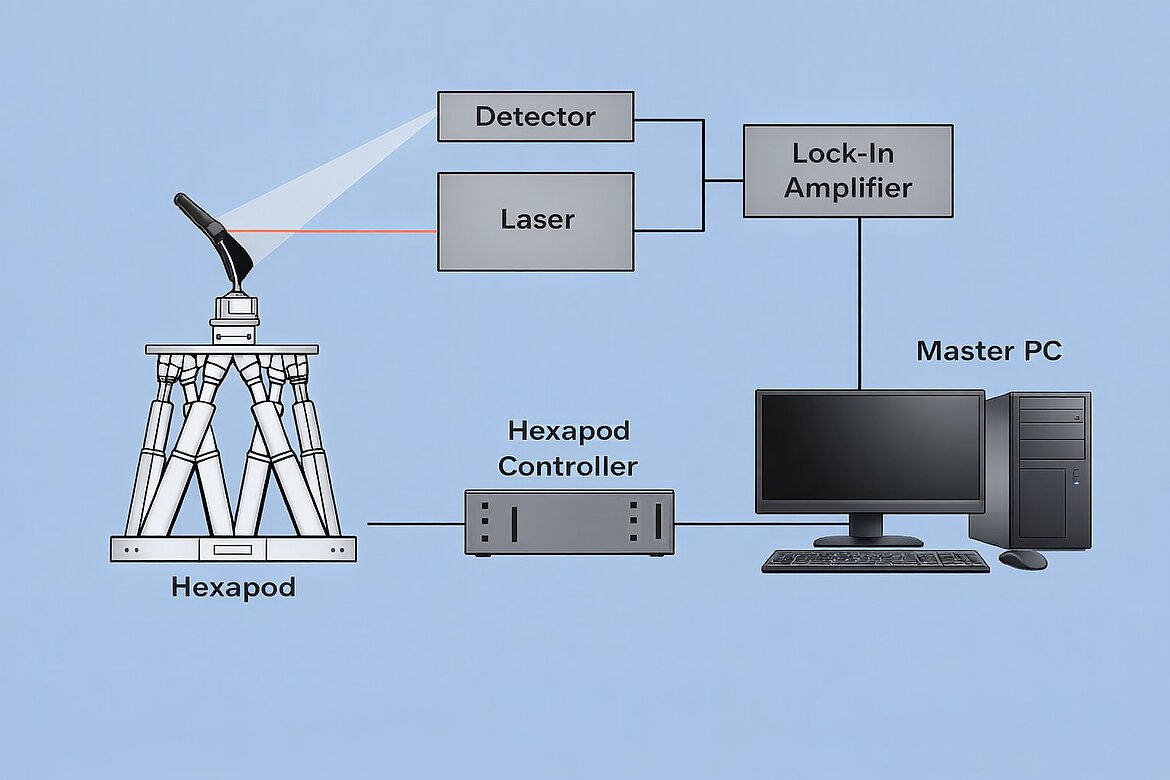
The University of Bremen and the Bremen Institute of Industrial Technology and Applied Work Science (BIBA) developed a system that enables photothermal measurements on complex, arbitrary surfaces. The kinematic platform of this system is based on a PI 6-axis hexapod, which can be coordinated with common industrial equipment, such as robots or machine tools. Test samples also included medical implants.
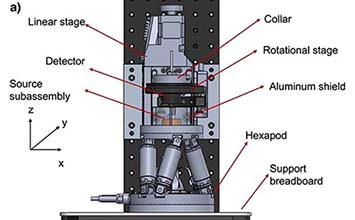
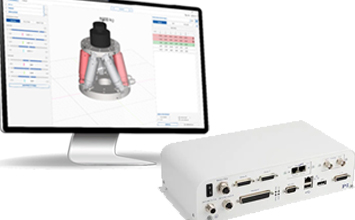
In the overall system concept, a master PC controls the complete testing setup, including the detector, laser, and lock-in amplifier. The hexapod and its controller form the motion subsystem. The laser is triggered via the lock-in amplifier, while the detector sends heat-wave propagation data back to the master PC. Motion commands are transmitted from the PC to the hexapod controller in Cartesian coordinates. The controller then performs the required coordinate transformation, calculates the trajectory, and drives the individual hexapod struts accordingly.
Photothermal inspection requires a precisely defined angle of incidence for the laser beam. On curved surfaces, this demands accurate knowledge of both the position and orientation of the area being tested. The system derives this information from the geometric data describing the sample and generates the corresponding control sequences automatically.
Before photothermal inspection, the test piece is scanned in its mounted position using fringe-projection techniques. The scan data is used to divide the surface into relatively flat segments and determine the orientation of each. The normal vector of every segment serves as the basis for generating motion commands that align the sample correctly with respect to the laser beam.
By using an industrial-grade 6-degree-of-freedom hexapod system, many previously manual steps can be automated. The hexapod can orient the test piece almost arbitrarily in space, opening new possibilities for photothermal inspection of complex surfaces.


Blog Categories
- Aero-Space
- Air Bearing Stages, Components, Systems
- Astronomy
- Automation, Nano-Automation
- Beamline Instrumentation
- Bio-Medical
- Hexapods
- Imaging & Microscopy
- Laser Machining, Processing
- Linear Actuators
- Linear Motor, Positioning System
- Metrology
- Microscopy
- Motorized Precision Positioners
- Multi-Axis Motion
- NanoAutomation
- Nanopositioning
- Photonics
- Piezo Actuators, Motors
- Piezo Mechanics
- Piezo Transducers / Sensors
- Precision Machining
- Semicon
- Software Tools
- UHV Positioning Stage
- Voice Coil Linear Actuator
- X-Ray Spectroscopy