PRIME: Fiber-Optic Fabrication Breakthrough Enables Advanced Neuroscience Exploration at WUSTL
“Disco Ball” Fiber Manufactured with Ultrafast Lasers; Multi-Axis Precision Motion Delivered by Pi’s A-311 Planar Air-Bearing XY Stage and V-308 High-Speed Nanofocusing Stage

Optogenetics is a neuroscience technique that uses light to precisely activate or silence genetically modified neurons, enabling real-time control of brain activity. Optogenetics was first demonstrated as a practical neuroscience tool in 2005, when Karl Deisseroth and colleagues showed that genetically modified neurons could be controlled with light.
Optical fibers enable optogenetics by delivering light to activate or silence neurons deep within the brain, but conventional fibers are limited to illuminating a single target. Studying complex neural circuits requires light delivery to hundreds or even thousands of locations, an impractical task with traditional multi-fiber approaches.

To overcome this limitation, researchers at Washington University in St. Louis, including engineers and neuroscientists from the Hu and Kepecs labs, developed a single optical fiber capable of steering light in many directions simultaneously—effectively creating a controllable “disco ball” inside the brain.
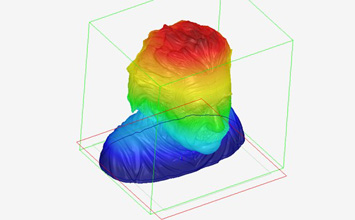
Using ultrafast-laser 3D microfabrication, Hu’s team, led by postdoctoral researcher Shuo Yang, inscribed approximately 1,000 microscopic grating emitters into a fiber no thicker than a human hair, enabling multi-site optical stimulation from a single minimally invasive implant. This technology, called PRIME (Panoramically Reconfigurable IlluMinativE), was introduced in a recent Nature Neuroscience study and provides programmable, multidirectional light emission from a single fiber.
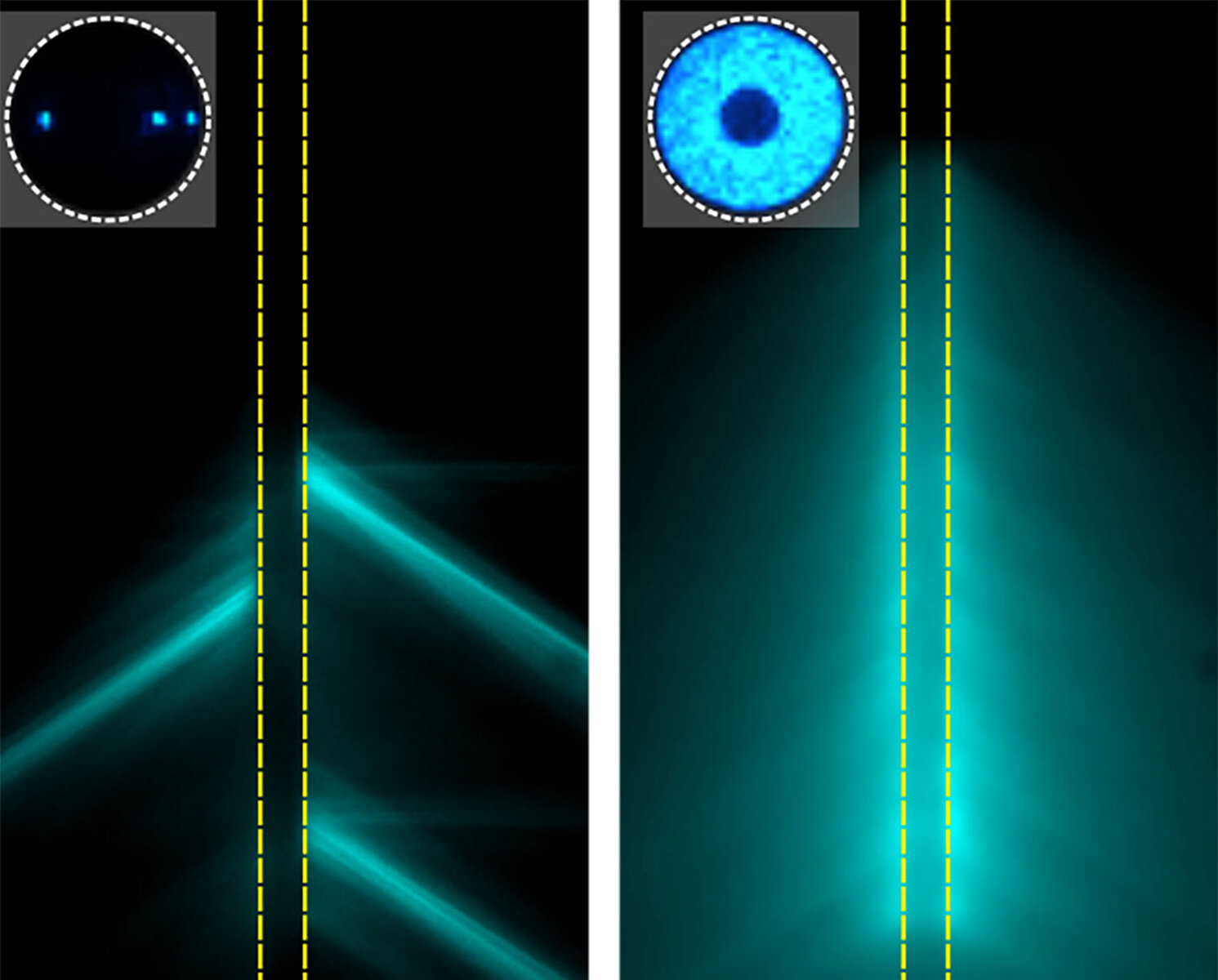
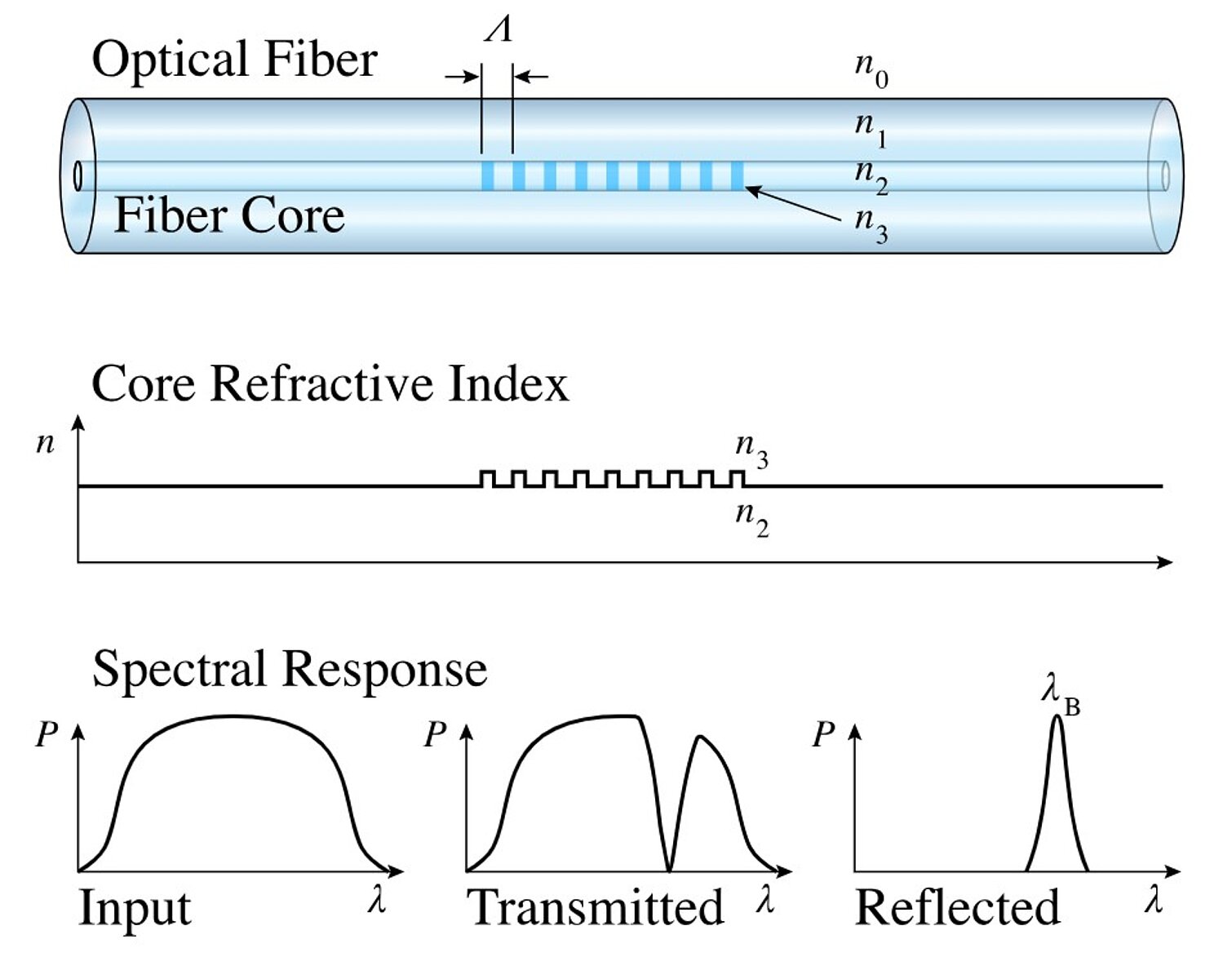
Rather than relying on conventional tilted Fiber Bragg Gratings (FBGs) used in telecommunications, PRIME employs discrete, individually laser-written micro-gratings, each with its own orientation, depth, and position. These structures act as tiny, addressable out-couplers—directional mirrors embedded along the fiber—that redirect light into selected angles. Light targeting is achieved through spatial beam steering and timing rather than wavelength switching, allowing researchers to selectively activate individual nodes or illuminate all sites simultaneously for large-scale neural modulation.
Successful Stimulation of the Brain
In proof-of-concept experiments, a research team led by Shuo Yang successfully used PRIME to stimulate distinct subregions of the superior colliculus in freely moving animals, triggering specific behaviors such as freezing or escape. This capability provides an unprecedented window into the spatiotemporal dynamics of brain circuits and opens new possibilities for precision neuroscience.
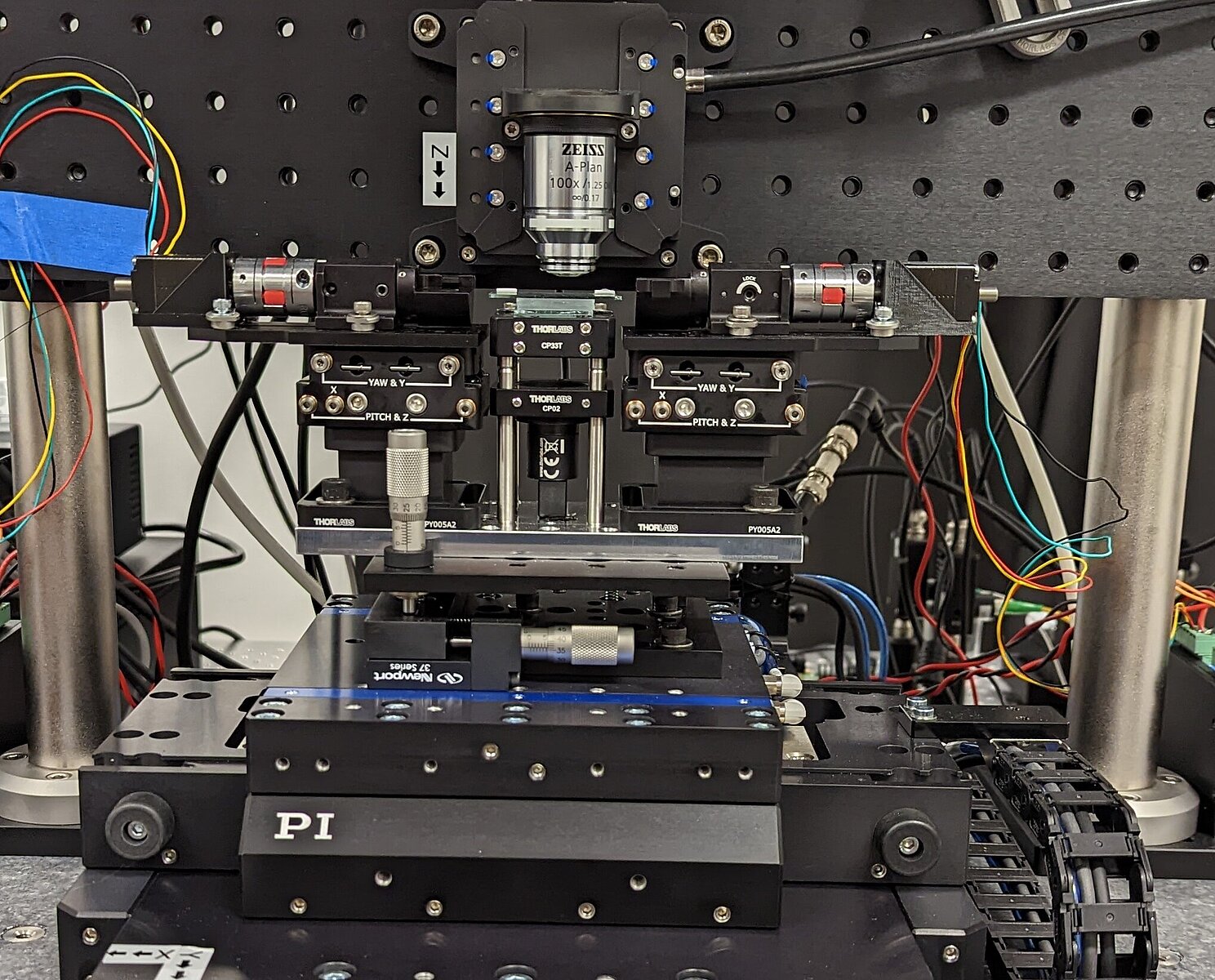
Translating PRIME’s optical innovation into practical neuroscience tools required sub-micron positioning and ultra‑rapid movement—exactly where PI’s motion control algorithms and positioning stages excel.
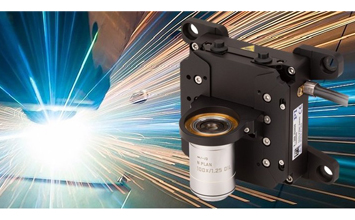
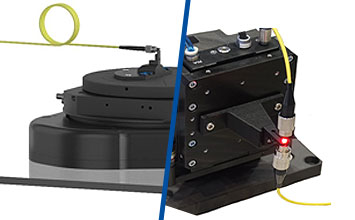
The microfabrication process of the Fiber Bragg Gratings is based on synchronizing ultrafast lasers with precise multi-axis motion control, demanding nanometer-level stability and repeatability. To meet these requirements, the researchers selected PI’s A-311 true planar air-bearing XY stage and V-308 nanofocusing stage; platforms proven in demanding laser-processing and microscopy applications.
Without nanometer-level precision wavelengths wander, gratings become inconsistent, and advanced designs become impossible.
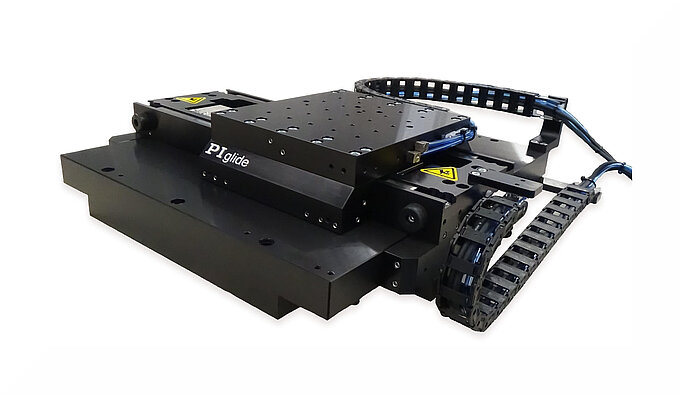
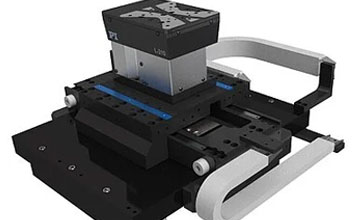
A‑311 Air‑Bearing XY Planar Scanner
High-precision XY scanning: Travel ranges from 50×50mm up to 300×300mm with 1 nanometer resolution.
- Frictionless direct-drive performance: Ironless linear motors enable speed up to 2m/s and acceleration up to 27.5 m/s², ideal for dynamic ultrafine alignment.
- Low-profile, cleanroom-ready design: The air-bearing system eliminates surface wear and friction-induced particle generation, reducing contamination—essential for delicate optical experiments.
Role in PRIME: The A-311 was used to inscribe micro-gratings into the PRIME fiber with nanometer-level positioning precision over a millimeter range, a capability crucial for mapping neural circuits spanning from microns to millimeters.
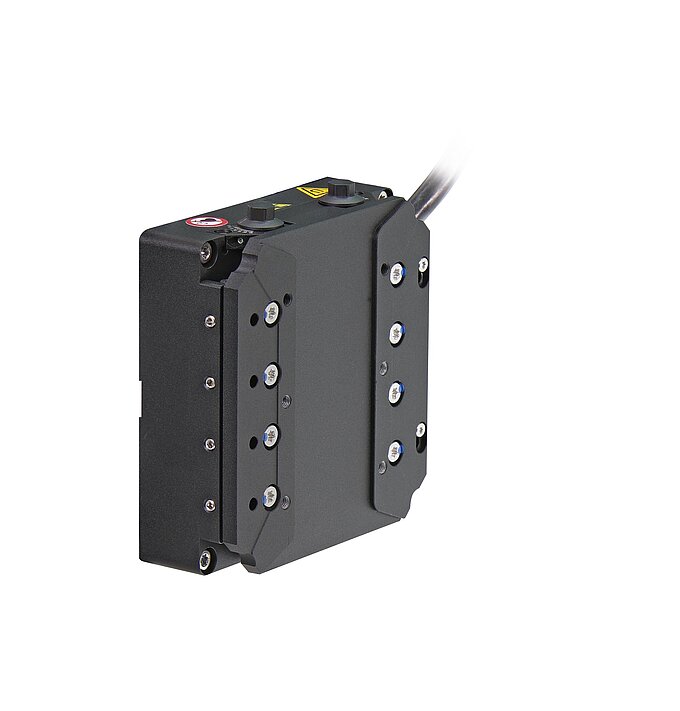
V‑308 Vertical NanoFocusing Translation Stage with Voice-Coil Drive and Nanometer Resolution
Vertical motion with nanometer precision: Offers 7mm of Z‑axis travel, 10nm incremental motion, and 25nm bidirectional repeatability.
- High dynamics: Voice-coil motor delivers speeds up to 200 mm/s, sub-nanometer encoder readbacks, and fast settling times—tailored for depth scanning.
- Counterbalance and closed-loop control: Built-in magnetic counterbalance supports heavy micro‑optics; remote control integration ensures stable and repeatable performance.
Role in PRIME: The V‑308 enables rapid and precise depth adjustment of laser focus, ensuring optimal machining precision for the grating elements.
Synergy: Complete 3D Control for Neuroscience Discoveries
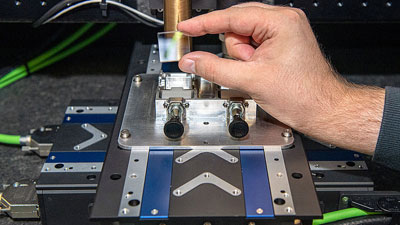
By combining PI’s A‑311 air-bearing XY-stage for planar actuation with the V‑308 Z-stage for vertical nano-focusing, researchers gained full 3D-positioning control during the laser direct-writing process. This allowed:
- Dynamic targeting: The fiber can be scanned laterally and have its depth adjusted to flexibly target any of the 1,000+ grating sites.
- High‑fidelity stimulation: Nanometer-level motion ensures optical beams stay on‑target, enhancing specificity and reducing off‑target effects.
- Repeatable experiments: Closed‑loop systems ensure consistent beam delivery across repeated trials, a necessity for robust behavioral neuroscience experiments.
Conclusion
PRIME’s elegant integration of laser‑written gratings inside an ultrafine fiber transforms deep‑brain modulation. Its production is enabled by PI’s state‑of‑the‑art motion systems: the A‑311 XY scanner for swift and accurate lateral positioning, and the V‑308 voice‑coil Z‑stage for fine axial control. Together, they create a 3D precision motion backbone enabling the fiber gratings to light up new frontiers in neuroscience, much like a disco ball illuminating a dance floor.




Blog Categories
- Aero-Space
- Air Bearing Stages, Components, Systems
- Astronomy
- Automation, Nano-Automation
- Beamline Instrumentation
- Bio-Medical
- Hexapods
- Imaging & Microscopy
- Laser Machining, Processing
- Linear Actuators
- Linear Motor, Positioning System
- Metrology
- Microscopy
- Motorized Precision Positioners
- Multi-Axis Motion
- NanoAutomation
- Nanopositioning
- Photonics
- Piezo Actuators, Motors
- Piezo Mechanics
- Piezo Transducers / Sensors
- Precision Machining
- Semicon
- Software Tools
- UHV Positioning Stage
- Voice Coil Linear Actuator
- X-Ray Spectroscopy