Products - PI (Physik Instrumente) L.P.
A-323 Air Bearing Scanner Advances Wafer Metrology
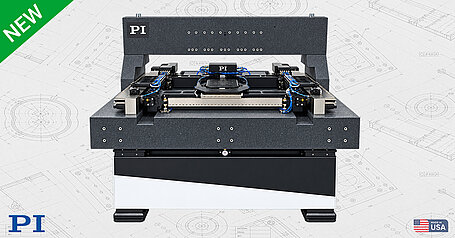
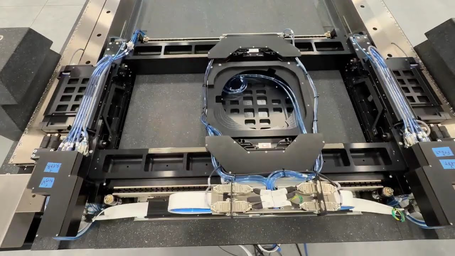
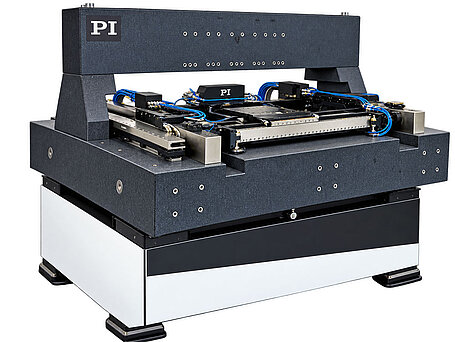
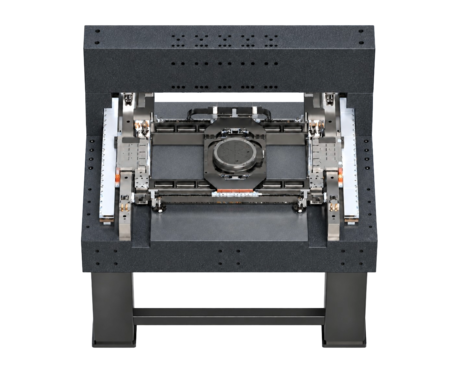
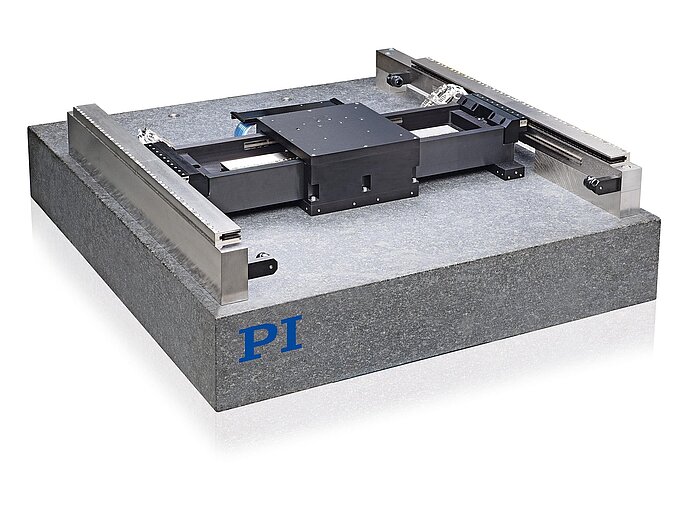
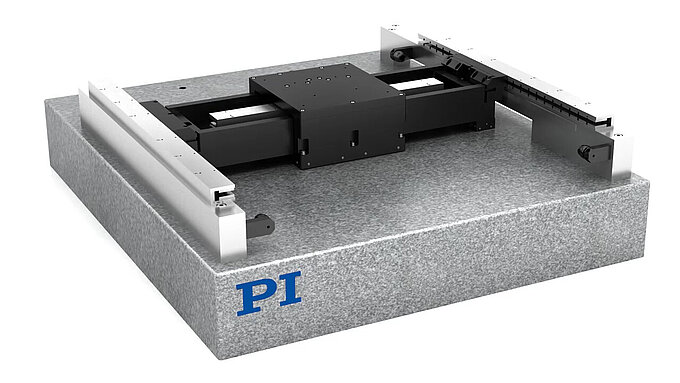
PI’s A-323 planar air bearing scanner supports high-throughput semiconductor inspection, metrology, and photonics applications. Designed and manufactured in the USA, it builds on the successful A-322 platform with a new architecture engineered to improve precision and repeatability, enable higher acceleration, and reduce step-and-settle times.
The basic configuration provides 500 × 500 mm XY travel, maximum velocity of 2 m/s, and approximately 2 g acceleration. Specified accuracy is 0.1 µm, with pitch and yaw performance of 10 µrad and 2 µrad, respectively.
Lower Position of Payload Improves Dynamic Performance
A split-beam cross-axis design places the payload lower and closer to the motor force plane, reducing pitching and rocking during acceleration. The architecture also reduces the Abbe offset between the payload and encoder measurement plane, helping limit positioning errors caused by angular motion. A gantry configuration improves yaw control across the working area.
Reaction-Force Transfer Supports Faster Settling
Rapid positioning can introduce vibration that delays measurement after a move. The A-323 redirects motor reaction forces into the machine frame, reducing excitation of the precision positioning structure. This approach reduces disturbances during high acceleration moves and supports faster settling following a step.
Flexible Integration of Additional Motion Axes
A central pocket accommodates application-specific motion modules, including PI’s A-523 Z-tip/tilt stage, a compact 5 mm Z stage, a rotary axis, or combined rotary/Z/tilt modules. Keeping these additional axes low helps preserve the platform’s dynamic advantages while providing the motion needed for sample positioning and alignment.
Newly developed air-bearing pucks improve stiffness and stability. Integrated cable tracks, pneumatic routing, and cooling provisions simplify installation and integration of customer-provided equipment into larger automation and metrology systems.
Inside the A-323: Engineering Precision Under Dynamic Loads
The A-323’s design addresses a challenge in high-throughput inspection: accelerating a payload rapidly while keeping the measurement structure stable. Beyond the architecture described above, several engineering details help explain how the platform manages angular errors, bearing loads, motor forces, and cable-induced disturbances.
Wider Drive and Encoder Spacing Improves Yaw Control
Compared to the existing high-end A-322 Ultra model, which features a cross-axis with two motors and two encoders, the A-323 places these drive and feedback points substantially farther apart, providing greater leverage for controlling rotation around the vertical axis.
This matters across a wafer or other extended workpieces. The linear positioning error caused by yaw increases with distance from the rotation center. A small angular deviation that has little effect near the center can produce a more significant error near the edge of a 300 mm wafer. Wider drive and encoder spacing are designed to improve bidirectional positioning behavior and maintain precision across the working area.
Managing Reaction Forces at Their Source
The reaction-force architecture allows much of the resulting reaction energy to be directed into the surrounding frame, reducing the disturbance transmitted directly to the granite.
The benefit extends beyond the moving stage. Optics, cameras, and sensors mounted on the granite bridge can also be affected when the base reacts to stage motion. Reducing this excitation supports a more stable relationship between the workpiece and measurement equipment during acceleration, settling, and the transition to constant-velocity scanning.
Bearing Stiffness and Payload Height Work Together
A revised air-bearing nozzle and bearing implementation provides a stiffer air film. Opposing bearings help maintain the magnetic guiding preload during high acceleration.
Integrating the payload and additional axes within the central pocket also reduces overturning moments during acceleration and deceleration. This helps limit structural excitation and reduces the risk of unloading an air bearing or closing its operating gap during aggressive motion.
Motor Sizing Determines Sustained Dynamic Performance
The current design has already demonstrated acceleration up to 2 g. At this level, the principal constraints are motor peak force, sustained RMS force, and thermal loading rather than the fundamental stage structure.
Liquid-cooled motors help manage heat, and with application-related motor sizing and cooling (matched to the payload and duty cycle) further improvements are possible. The architecture can accommodate larger motors where greater sustained dynamic performance is required.
Cable Routing Supports Repeatable Motion
Cable management affects positioning performance as well as installation. Asymmetric cable forces can introduce disturbances that vary with stage position and direction of travel. The A-323 supports symmetrical cable loops and multiple routing and access options to help manage these forces while accommodating customer equipment.
Together, these design choices support a configurable platform for wafer positioning and broader inspection and metrology applications. Final performance depends on the integrated payload, selected motion modules, motor configuration, and operating conditions.
Discuss Your Application
Contact PI’s engineering team to discuss scanning requirements, payload configuration, additional motion axes, and system integration.
Read more: Five-Axis Air Bearing Stage